I'll be offline until Sunday when I get back from the Golden Temple. I'm not taking my computer with me, so I'll have some catching up to do when I return!
Namaste!
Friday, September 19, 2008


The House of God
Thursday
I’m too full at breakfast to eat my banana. I throw it in my bag so I can give it to a beggar should the occasion arise.
After eating, I call on Mister Singh again. His isn’t home. His daughter-in-law comes down to see me. What did I need? I tell her I need the name of the hotel and the phone number of the taxi service Mister Singh was talking about. I leave the papers he gave me so he can write it on them. She says no problem. He’ll be home in an hour and they’ll get this done and have the papers sent back to my room at the guesthouse.
I catch my ride with time to spare today.
We stop at a red light and I see an old woman walking from car to car, tapping at the windows. I think, “Good candidate for my banana,” and dig it out of my backpack.
There’s a moment when she sees me, freezes, and tilts her head. It’s like I can see her getting a great idea. She hunches over and starts dragging her right leg behind her. Suddenly she is a crippled hunchback. She limps up to my window and raps on it. I roll it down and hand her the banana. She takes it but starts rambling in Hindi, clearly explaining to me that she wasn’t asking for a banana, stupid. She holds up a rupee. She wants money. I shake my head. Take the banana, lady. She rambles on while I roll up the window. She does one limp away from my car, then straightens up again and walks off as normally as could be. It comes off like a comedy routine. I hope she doesn’t slip on the banana peel.
At work I’m finally making some good progress on chapter six. I can see that I’ll be able to finish it by Friday.
After lunch I take a walk with Shabnum. She was reading my blog and says I didn’t get it quite right about the hijras. They aren’t servants to their gurus. They’re more like disciples or followers or students. I’m glad I have good editors.
There is an email in my inbox that says my package arrived. At first I just ignore it. I think it means that a package has been sent to me, but then I see it says it was signed for by someone with an Indian name. I must have a package here somewhere. Jane, my friend from work, asked if she could send me something a little while back, but I didn’t know if she really would. Now I think she actually has gone to the effort, but I wonder why no one here has brought it to me. I write down the tracking number and go up to the front desk. Is there a package here for me? Bibouti calls the guard shack out front. Yes, they have my package. I guess they were just waiting for me to psychically find out about it and track it down.
I go outside. They speak to me in Hindi and point to the address on the box’s label and laugh. I’m always good for a laugh here in India, apparently. I take the box down to my desk and pull at the packing tape. I can’t wait until I’m home to open it. Besides, this day has been dragging on and on. I need a little something to break up the monotony of currency forwards and futures and cross-hedging and yield curves.
No. I should save the package for tonight. I’ll be stuck at home if it rains with no company. It will be a great diversion.
No. I just have to peek. I’ll just peek.
It takes me a good five minutes just to get the tape off. I don’t have a pair of scissors handy, so I have to get creative. I use a binder clip. I told Jane that some salty snacks would be nice. There’s nothing really in India save potato chips and I don’t really like those. I lift open a flap of the box and decide not to disturb the contents too much. But what a great surprise. There is lip gloss inside. And it’s Carmex. I love lip gloss, and my lips are pretty parched, especially after my long day in the beating sun at Agra. I open the Carmex and decide I’ll leave it at work so I always have it to use during the day.
I peek a little more. There’s a magazine in there! An American magazine. How awesome. And there are two cards that I don’t open. This is way better than the salty crackers I was expecting. This isn’t a box of salty snacks. This is a box full of home.
In the car on the way back to the guesthouse I can wait no longer. I have to read the cards. The first one I open isn’t from Jane at all. It’s from another coworker, Linda. She tells me that I even made a visit to the eye doctor fun to read about. I am so buoyed. I love to know that people are actually reading my blog and, even better, enjoying it.
It begins to rain again, but today is not as bad as yesterday. I get home just before seven. I turn my funky skeleton key in the door and open it with baited breath, hoping to see the papers from Mister Singh sitting on my table with the information about the hotel written on them. There is nothing. Now what? Now I have to bother him again? Or do I just go to Armritsar with no hotel lined up? That was Susie’s plan. But Susie also uses the water here to brush her teeth and takes auto-rickshaw rides in the dark. Susie is more adventurous than I am.
I decide to let this issue simmer for a bit while I dig in to my package. There are lens cloths for cleaning your glasses. And a package of band aids. And hygienic toilet seat covers. I laugh out loud. Someone has been reading my blog very closely! Then I find a small white box with colorful ribbons tied all around it. There is a small purple note taped to the top with a quote on it, “Life isn’t about finding yourself. Life is about creating yourself.” The note is signed by my director, the woman who first suggested the newdirections program to me, Nancy. Inside there is a smooth piece of quartz with the word “Create” etched into it. It’s beautiful. I cry from the kindness of all these people at home who took the time and the effort to do this for me. First I’m lucky enough to be able to participate in this program, then I’m lucky enough to have people like this cheering me on, supporting me. If I was feeling a bit alone today, I am no longer.
I open up a bag of Ritz crackers that was in the package and wander downstairs to find Pachu. “Did anyone drop off some papers for me?”
“Newspaper?” he asks.
“No. Paper. Just paper, with writing on it.”
“Oh, paper. Yesterday,” he says.
“Yes, paper like they brought yesterday. Did anyone bring some today?”
“No. No paper.”
It’s still raining out, so I decide that I’ll just call Mister Singh. I find his business card and dial him up. “Yes,” he says. “I wanted to talk to you. Why did you send back the papers I gave you?”
“Thank you for those. I just wanted you to write the hotel information on them.”
“Yes,” he says. “Give me the coach number of your train so I can call for your cab.”
I grab my ticket and tell him it’s 2A.
“That’s it? That’s the coach number?”
“Yes.”
“No. The coach number.”
“That’s what it says.”
“Maybe sometime you can come over and show me.”
Sometime? My train leaves tomorrow. “Can I come over now? I can show you now.”
“Okay,” he says and perfunctorily hangs up.
I grab my tickets and my umbrella and walk next door. The guard waves me in. I see Mister Singh through his bedroom window tying his turban. The door is closed. I get the guard. Should I just walk in or is there a doorbell? The guard opens the door for me and shows me to the sitting room.
Mister Singh joins me there in a minute. “Yes, I wanted the information about your train so I can call for the taxi, you see. He will meet you at the station and take you to the hotel so you can wash up. Then you will go straight to the Golden Temple. He will be holding a sign for you. We went on an eighteen-day trip to Europe and there was a French woman with us all the time. When you travel you need help so you do not have to worry.”
He leaves the room and comes back with a business card from the hotel where he, indeed, has made reservations for us. I am so relieved.
“Let’s just set this now,” he says, and gets on his cell phone to the taxi service. I can understand a few English words sprinkled into his Punjabi here and there. Miss Vicki, he says. Golden Temple, he says. Saturday.
“It is set,” he says, hanging up. When we reach the station, we should look for a replica of the Golden Temple, a little scale model of it. The taxi driver will be waiting there with a sign that has my name on it. I’m amazed he’s arranged all this for me.
Poonam walks into the room from out of nowhere. I am excited to see her. She is always so full of praise and joy. I throw up my arms and say hello. She mirrors my gesture. “I worship this man,” she croons as she sits down beside me. “You know why? Because he is so kind and so noble. I am so lucky to have such a friend. He has good heart. If there is someone to help, he will help. Just anyone.”
“I know,” I tell her. “He just set up my whole trip to Armritsar for me.”
“When you think of India, you will think of this man!” she exclaims.
“And I’ll think of you too,” I tell her. She is bashful about this.
“Oh, thank you,” she sings and touches my arm.
Mister Singh draws me a picture of the layout of the temple and shows me the path we’ll have to walk to get inside of it. “Remember the gate you come in so you can find your driver,” he tells me. Here there is a four hundred year old tree with berries on it that the birds like to eat at dawn. Here is the place where the profit used to sit to watch the temple being built. Here is where we can go to sit for an hour or so just to enjoy, or whatever we like.
A house helper brings three plates and some chaat: there is spicy apple and banana and pomegranate seeds. “There is chili,” he says looking concerned, but I am already gobbling. “This is okay?”
This is fine.
Next Mister Singh has another house helper bring a stack of headscarves for me to borrow and a bag to keep them in. We’ll all need to cover our heads when we go inside. There should be enough here for me and each of my friends.
Have I had my dinner?
No.
Then would I like to stay?
Is it okay?
Yes. Poonam tells me I should stay. Okay, then.
Mister Singh shows me a directory he produced for the people at his gurudwara. The front of it is filled with information about Sikhism which he begins explaining to me. Poonam grabs my chin as I lean forward to listen and smiles. She says I’m his “gurushishya,” his student, and soon I’ll know all about the Sikhs.
Mister Singh talks about Sikh marriages, the status of women in Sikh society, the meaning of the bracelet that Sikhs wear and, as always, the fact that the Sikhs fought against the Mughuls and abolished caste.
Poonam tells me, as always, that Mister Singh is a good man. He takes care of his wife so well. She needs so much attention and he is always there to give it to her.
Mister Singh says he is fortunate to be able to care for his wife. He is fortunate to have the money to do it with; it costs 1.25 lakh a month. Even so, even with this expense, he likes to give to charity. It is a Sikh value to help others. Whatever we do, we should help others. And we should be thankful for what we have. We shouldn’t complain to God whatever happens. We should bow our heads.
Sikhs don’t bow their heads before anything but their holy book. There are no idols. They don’t even bow to their gurus. Their gurus, he says, are like dust on the feet of God. They only bow to the book because in it is everything they need to know. It contains the wisdom of every religion that believes in one God only: Judaism, Christianity, Islam. There are quotes from all these religions in it.
The phone rings. It is Mister Kandhari. Mister Singh tells him in Hindi how he’s set up my trip for me. I understand, again, a few English words sprinkled throughout the conversation: trip, taxi, tomorrow.
He hangs up. Mister Kandhari is, how do you say it, a man-eye-oc about his garden. He gets up at five o’clock every day and works on it for three hours with three of his house helpers, watering, trimming, fertilizing.
Poonam says this work keeps him moving. Otherwise, he would get old.
Mister Singh asks how many house helpers God has? How big is God’s house? How many people does he need to help him? These are deep questions, he says.
He asks if I’d like to wash up before eating. I walk to the bathroom. On my way out, he shows me a file of papers. It’s receipts and records of all the blood drives he’s helped to run in Delhi. Then he’s helped with eye donations. And he raised money for a cricket player with kidney failure. The papers go all the way back to the 80s. They are a catalogue of good works.
Dinner is served. There are two vegetable dishes and a dal. Today, there is also tandoori roti, a thicker bread baked in a stone oven. Mister Singh gets out the pickles again, offering me first something stewing in mustard seed. This actually tastes good even if it looks like a long dead body in a jar. Then he gets out the lime pickles and plops one on my plate against my objections. I scoop it up to eat it and Poonam puts out a hand, “No!”
No?
No! You’re not supposed to eat the whole thing like that. You’re just supposed to touch your roti to it to let it get a little bit of the flavor. No wonder the lime pickle was so bad last time I tried it. I touch my bread to it and eat it. This is much more palatable.
After dinner, there is yet another large jar that we’ll try something from. These are olives, Mister Singh tells me, though they look more like peeled kiwi fruit.
A house helper puts an olive on each of our plates. “It’s very healthy,” Poonam stresses.
I eat it and it’s good, but it tastes like solid sugar. It’s candied. I wonder what is healthy about it, but don’t ask.
I ask Mister Singh what time it is. It’s ten. Ten? I’m late for my Skype call with Scott. I tell him I have to leave but thank him profusely for all his help. I reach to shake his hand and he extends his but doesn’t grasp mine with his thumb. He kind of keeps his hand together while we shake. He doesn’t quite have this gesture down like Mister Kandhari does. When I fold my hands and bow to Mister Kandhari, he acts like I’m being silly and grabs my hand to shake. I think maybe Mister Singh is more traditional in this regard. Next time, I’ll try bowing to him.
I grab my bagful of scarves and the gurudwara Mister Singh has given me and dash off back to the guesthouse where I scramble to set up my computer. I can’t believe my good fortune this evening to have so many people thinking about me and helping me out.
And all I’ve been able to do lately is obsess about getting that hotel name out of Mister Singh. Maybe I need to think more about others. Maybe I need to take a lesson from my neighbor and coworkers. How many people does it take to run the house of God? As many as He can get.
I’m too full at breakfast to eat my banana. I throw it in my bag so I can give it to a beggar should the occasion arise.
After eating, I call on Mister Singh again. His isn’t home. His daughter-in-law comes down to see me. What did I need? I tell her I need the name of the hotel and the phone number of the taxi service Mister Singh was talking about. I leave the papers he gave me so he can write it on them. She says no problem. He’ll be home in an hour and they’ll get this done and have the papers sent back to my room at the guesthouse.
I catch my ride with time to spare today.
We stop at a red light and I see an old woman walking from car to car, tapping at the windows. I think, “Good candidate for my banana,” and dig it out of my backpack.
There’s a moment when she sees me, freezes, and tilts her head. It’s like I can see her getting a great idea. She hunches over and starts dragging her right leg behind her. Suddenly she is a crippled hunchback. She limps up to my window and raps on it. I roll it down and hand her the banana. She takes it but starts rambling in Hindi, clearly explaining to me that she wasn’t asking for a banana, stupid. She holds up a rupee. She wants money. I shake my head. Take the banana, lady. She rambles on while I roll up the window. She does one limp away from my car, then straightens up again and walks off as normally as could be. It comes off like a comedy routine. I hope she doesn’t slip on the banana peel.
At work I’m finally making some good progress on chapter six. I can see that I’ll be able to finish it by Friday.
After lunch I take a walk with Shabnum. She was reading my blog and says I didn’t get it quite right about the hijras. They aren’t servants to their gurus. They’re more like disciples or followers or students. I’m glad I have good editors.
There is an email in my inbox that says my package arrived. At first I just ignore it. I think it means that a package has been sent to me, but then I see it says it was signed for by someone with an Indian name. I must have a package here somewhere. Jane, my friend from work, asked if she could send me something a little while back, but I didn’t know if she really would. Now I think she actually has gone to the effort, but I wonder why no one here has brought it to me. I write down the tracking number and go up to the front desk. Is there a package here for me? Bibouti calls the guard shack out front. Yes, they have my package. I guess they were just waiting for me to psychically find out about it and track it down.
I go outside. They speak to me in Hindi and point to the address on the box’s label and laugh. I’m always good for a laugh here in India, apparently. I take the box down to my desk and pull at the packing tape. I can’t wait until I’m home to open it. Besides, this day has been dragging on and on. I need a little something to break up the monotony of currency forwards and futures and cross-hedging and yield curves.
No. I should save the package for tonight. I’ll be stuck at home if it rains with no company. It will be a great diversion.
No. I just have to peek. I’ll just peek.
It takes me a good five minutes just to get the tape off. I don’t have a pair of scissors handy, so I have to get creative. I use a binder clip. I told Jane that some salty snacks would be nice. There’s nothing really in India save potato chips and I don’t really like those. I lift open a flap of the box and decide not to disturb the contents too much. But what a great surprise. There is lip gloss inside. And it’s Carmex. I love lip gloss, and my lips are pretty parched, especially after my long day in the beating sun at Agra. I open the Carmex and decide I’ll leave it at work so I always have it to use during the day.
I peek a little more. There’s a magazine in there! An American magazine. How awesome. And there are two cards that I don’t open. This is way better than the salty crackers I was expecting. This isn’t a box of salty snacks. This is a box full of home.
In the car on the way back to the guesthouse I can wait no longer. I have to read the cards. The first one I open isn’t from Jane at all. It’s from another coworker, Linda. She tells me that I even made a visit to the eye doctor fun to read about. I am so buoyed. I love to know that people are actually reading my blog and, even better, enjoying it.
It begins to rain again, but today is not as bad as yesterday. I get home just before seven. I turn my funky skeleton key in the door and open it with baited breath, hoping to see the papers from Mister Singh sitting on my table with the information about the hotel written on them. There is nothing. Now what? Now I have to bother him again? Or do I just go to Armritsar with no hotel lined up? That was Susie’s plan. But Susie also uses the water here to brush her teeth and takes auto-rickshaw rides in the dark. Susie is more adventurous than I am.
I decide to let this issue simmer for a bit while I dig in to my package. There are lens cloths for cleaning your glasses. And a package of band aids. And hygienic toilet seat covers. I laugh out loud. Someone has been reading my blog very closely! Then I find a small white box with colorful ribbons tied all around it. There is a small purple note taped to the top with a quote on it, “Life isn’t about finding yourself. Life is about creating yourself.” The note is signed by my director, the woman who first suggested the newdirections program to me, Nancy. Inside there is a smooth piece of quartz with the word “Create” etched into it. It’s beautiful. I cry from the kindness of all these people at home who took the time and the effort to do this for me. First I’m lucky enough to be able to participate in this program, then I’m lucky enough to have people like this cheering me on, supporting me. If I was feeling a bit alone today, I am no longer.
I open up a bag of Ritz crackers that was in the package and wander downstairs to find Pachu. “Did anyone drop off some papers for me?”
“Newspaper?” he asks.
“No. Paper. Just paper, with writing on it.”
“Oh, paper. Yesterday,” he says.
“Yes, paper like they brought yesterday. Did anyone bring some today?”
“No. No paper.”
It’s still raining out, so I decide that I’ll just call Mister Singh. I find his business card and dial him up. “Yes,” he says. “I wanted to talk to you. Why did you send back the papers I gave you?”
“Thank you for those. I just wanted you to write the hotel information on them.”
“Yes,” he says. “Give me the coach number of your train so I can call for your cab.”
I grab my ticket and tell him it’s 2A.
“That’s it? That’s the coach number?”
“Yes.”
“No. The coach number.”
“That’s what it says.”
“Maybe sometime you can come over and show me.”
Sometime? My train leaves tomorrow. “Can I come over now? I can show you now.”
“Okay,” he says and perfunctorily hangs up.
I grab my tickets and my umbrella and walk next door. The guard waves me in. I see Mister Singh through his bedroom window tying his turban. The door is closed. I get the guard. Should I just walk in or is there a doorbell? The guard opens the door for me and shows me to the sitting room.
Mister Singh joins me there in a minute. “Yes, I wanted the information about your train so I can call for the taxi, you see. He will meet you at the station and take you to the hotel so you can wash up. Then you will go straight to the Golden Temple. He will be holding a sign for you. We went on an eighteen-day trip to Europe and there was a French woman with us all the time. When you travel you need help so you do not have to worry.”
He leaves the room and comes back with a business card from the hotel where he, indeed, has made reservations for us. I am so relieved.
“Let’s just set this now,” he says, and gets on his cell phone to the taxi service. I can understand a few English words sprinkled into his Punjabi here and there. Miss Vicki, he says. Golden Temple, he says. Saturday.
“It is set,” he says, hanging up. When we reach the station, we should look for a replica of the Golden Temple, a little scale model of it. The taxi driver will be waiting there with a sign that has my name on it. I’m amazed he’s arranged all this for me.
Poonam walks into the room from out of nowhere. I am excited to see her. She is always so full of praise and joy. I throw up my arms and say hello. She mirrors my gesture. “I worship this man,” she croons as she sits down beside me. “You know why? Because he is so kind and so noble. I am so lucky to have such a friend. He has good heart. If there is someone to help, he will help. Just anyone.”
“I know,” I tell her. “He just set up my whole trip to Armritsar for me.”
“When you think of India, you will think of this man!” she exclaims.
“And I’ll think of you too,” I tell her. She is bashful about this.
“Oh, thank you,” she sings and touches my arm.
Mister Singh draws me a picture of the layout of the temple and shows me the path we’ll have to walk to get inside of it. “Remember the gate you come in so you can find your driver,” he tells me. Here there is a four hundred year old tree with berries on it that the birds like to eat at dawn. Here is the place where the profit used to sit to watch the temple being built. Here is where we can go to sit for an hour or so just to enjoy, or whatever we like.
A house helper brings three plates and some chaat: there is spicy apple and banana and pomegranate seeds. “There is chili,” he says looking concerned, but I am already gobbling. “This is okay?”
This is fine.
Next Mister Singh has another house helper bring a stack of headscarves for me to borrow and a bag to keep them in. We’ll all need to cover our heads when we go inside. There should be enough here for me and each of my friends.
Have I had my dinner?
No.
Then would I like to stay?
Is it okay?
Yes. Poonam tells me I should stay. Okay, then.
Mister Singh shows me a directory he produced for the people at his gurudwara. The front of it is filled with information about Sikhism which he begins explaining to me. Poonam grabs my chin as I lean forward to listen and smiles. She says I’m his “gurushishya,” his student, and soon I’ll know all about the Sikhs.
Mister Singh talks about Sikh marriages, the status of women in Sikh society, the meaning of the bracelet that Sikhs wear and, as always, the fact that the Sikhs fought against the Mughuls and abolished caste.
Poonam tells me, as always, that Mister Singh is a good man. He takes care of his wife so well. She needs so much attention and he is always there to give it to her.
Mister Singh says he is fortunate to be able to care for his wife. He is fortunate to have the money to do it with; it costs 1.25 lakh a month. Even so, even with this expense, he likes to give to charity. It is a Sikh value to help others. Whatever we do, we should help others. And we should be thankful for what we have. We shouldn’t complain to God whatever happens. We should bow our heads.
Sikhs don’t bow their heads before anything but their holy book. There are no idols. They don’t even bow to their gurus. Their gurus, he says, are like dust on the feet of God. They only bow to the book because in it is everything they need to know. It contains the wisdom of every religion that believes in one God only: Judaism, Christianity, Islam. There are quotes from all these religions in it.
The phone rings. It is Mister Kandhari. Mister Singh tells him in Hindi how he’s set up my trip for me. I understand, again, a few English words sprinkled throughout the conversation: trip, taxi, tomorrow.
He hangs up. Mister Kandhari is, how do you say it, a man-eye-oc about his garden. He gets up at five o’clock every day and works on it for three hours with three of his house helpers, watering, trimming, fertilizing.
Poonam says this work keeps him moving. Otherwise, he would get old.
Mister Singh asks how many house helpers God has? How big is God’s house? How many people does he need to help him? These are deep questions, he says.
He asks if I’d like to wash up before eating. I walk to the bathroom. On my way out, he shows me a file of papers. It’s receipts and records of all the blood drives he’s helped to run in Delhi. Then he’s helped with eye donations. And he raised money for a cricket player with kidney failure. The papers go all the way back to the 80s. They are a catalogue of good works.
Dinner is served. There are two vegetable dishes and a dal. Today, there is also tandoori roti, a thicker bread baked in a stone oven. Mister Singh gets out the pickles again, offering me first something stewing in mustard seed. This actually tastes good even if it looks like a long dead body in a jar. Then he gets out the lime pickles and plops one on my plate against my objections. I scoop it up to eat it and Poonam puts out a hand, “No!”
No?
No! You’re not supposed to eat the whole thing like that. You’re just supposed to touch your roti to it to let it get a little bit of the flavor. No wonder the lime pickle was so bad last time I tried it. I touch my bread to it and eat it. This is much more palatable.
After dinner, there is yet another large jar that we’ll try something from. These are olives, Mister Singh tells me, though they look more like peeled kiwi fruit.
A house helper puts an olive on each of our plates. “It’s very healthy,” Poonam stresses.
I eat it and it’s good, but it tastes like solid sugar. It’s candied. I wonder what is healthy about it, but don’t ask.
I ask Mister Singh what time it is. It’s ten. Ten? I’m late for my Skype call with Scott. I tell him I have to leave but thank him profusely for all his help. I reach to shake his hand and he extends his but doesn’t grasp mine with his thumb. He kind of keeps his hand together while we shake. He doesn’t quite have this gesture down like Mister Kandhari does. When I fold my hands and bow to Mister Kandhari, he acts like I’m being silly and grabs my hand to shake. I think maybe Mister Singh is more traditional in this regard. Next time, I’ll try bowing to him.
I grab my bagful of scarves and the gurudwara Mister Singh has given me and dash off back to the guesthouse where I scramble to set up my computer. I can’t believe my good fortune this evening to have so many people thinking about me and helping me out.
And all I’ve been able to do lately is obsess about getting that hotel name out of Mister Singh. Maybe I need to think more about others. Maybe I need to take a lesson from my neighbor and coworkers. How many people does it take to run the house of God? As many as He can get.
A Room or No Room?
Wednesday
By Wednesday, the subject of the bombings has been exhausted. It comes up no longer in conversation, though it still appears in the headlines. The police are tracking down suspects, the paper says, though it’s a little vague on the specifics.
The larger headline today, the one that takes up almost all of page one, is about Lehman Brothers going bankrupt and how that will impact the Indian economy. India stands to lose 25,000 jobs because of this event, the article says. Banks, apparently, do a lot of outsourcing.
At about quarter to nine, I walk over to Mister Singh’s house, as per Mister Kandhari’s directions last night. Mister Singh’s guard is outside polishing a posh sedan. He ushers me through the marble foyer and into Mister Singh’s sitting room. He turns on the ceiling fan for me and goes to tell Mister Singh he has a caller. I hope I’m not intruding. I don’t usually just show up at people’s houses.
Mister Singh walks into the room and sits down on the couch opposite me. He’s dressed in earth tones except for his blue turban. His shorts bear his skinny legs. How am I doing? How did I like the dinner the other night at the gurudwara? The Sikhs are nothing like the Hindus, he tells me. Hindus divide society into four castes: the warriors, the holy, the workers and the untouchables. Sikhs think caste is wrong.
His house helper brings a large framed piece of art into the room for me to see. It is a painting of Guru Gobind Singh on horseback holding a sword and a falcon, pointing at a large floating book: the Guru Granth Sahib. Beside him are some versus about Sikhism. Mister Singh reads them aloud to me. The same versus appear on the back of the frame handwritten by the artist.
This artist, Mister Singh tells me, painted a map of India with a naked woman on it to represent Mother India. For this, he was thrown out of the country. It was very controversial.
What would I like? Chai? Coffee?
I tell Mister Singh I can’t actually stay for tea. I have to leave for work at nine o’clock. He looks at his watch. It is five minutes of nine.
He goes to his bookshelf and takes out the book on the Golden Temple that he showed me the evening I had dinner with him and Poonam. He’ll loan it to me this time. I should take it and read it before I go. It tells all about the temple.
I ask him the name of the hotel he’s called and made reservations at. We leave in two days and I’m getting antsy to finalize our plans. He tells it to me but it’s hard to pronounce. The first syllable sounds like “shit” and this throws me off completely. He says he’ll get me all the information I need. His daughter-in-law is on the Internet right now printing out some things. He’ll have them brought over to my guesthouse. What room am I in?
Room ten.
What?
Room ten.
What?
Ten. Sometimes Mister Singh’s English just turns off and he suddenly can’t understand what I’m saying at all. He finally gets it. Room ten. Okay. He’ll have the information sent over.
He walks me out and shows me his little courtyard garden. There are two busts of Roman gods and lots of potted plants. There is a bonsai garden that is unmistakably Mister Kandhari’s work. “It’s beautiful,” I tell him. He tells me again how he is responsible for the rock wall that laps around the park across the street from him. When it was windy, it would blow the dust into everyone’s houses, so he had this wall built in front of his house, then everyone else wanted it too. They had to pay just two thousand rupees a piece for it. Everyone did.
I’m anxious I don’t miss my ride. On Monday when I went to the Taj Mahal, I forgot to call Palminder and cancel my cab for the day, so he ended up sitting and waiting for me until he asked the guard and they told him I’d left in a different car. I don’t want Palminder to think I’ve ditched him again and just leave.
I don’t want to be an ungracious guest, but I need to go. Mister Singh finishes his little garden tour and bids me goodbye at his black metal gate. Outside I see Palminder parked and waiting for me. I jog back up to my room to grab my backpack and purse.
Amar stops by my desk early in the day and asks me what I think about the American economy. It’s in a frightening state, I say. We talk about the headlines, about job losses. We talk about how the banking system in India is different than that in the United States. There are hundreds of small banks here, as opposed to the few giant corporations that have swallowed up all the neighborhood banks in the US.
I tell Amar I tried to open a banking account when I first got here. Finance wanted me to pay for my taxi fare with a check they cut for me. I was trying to cash it and open an account with it, but they asked for so much information I didn’t know where to start. They wanted a passport, two additional passport photos, a statement from work, a statement from the place I was living. The list went on and on. I figure this is different if you live here. It’s probably not so difficult, but Amar says it is. Indians have no social security number, so to do anything, you have to find different ways of proving your identity. This explains some of the famous Indian bureaucracy I’ve seen. The government doesn’t necessarily know who lives here, who exists. So it’s more difficult to get a passport, a utility set up, even a credit card.
At lunch Amar talks about the literacy rate in India. It’s something like sixty percent. This is better than Pakistan, which is like forty nine percent. Amar says there’s free public schooling here, but parents still won’t send their children because to keep them out of school means they can work and earn money for the family. I think of all the little boys selling magazines I see in traffic almost daily and the little boy running the ride at the small carnival outside Kalkaji Mandir. Amar says there are organizations that try to help with this. CRY is one. CRY is a good organization? I ask. Because there was a man from CRY who came up to me one day last week when I was petting Acha, Baby and Baloo. He wanted me to donate money but I couldn’t write him a check and he wasn’t supposed to take cash donations. He wanted to follow me back to my room so I could get my wallet and give him cash. He could go the bank with it and get a draft, he said. I told him I would donate online, but he wouldn’t get credit for having solicited my donation that way. He gave me the hard sell. He said people are so willing to waste their money on expensive dinners and drinks, but nobody wants to give a little bit to help others. I told him I want to help, I just don’t want a strange man to follow me back to my room so I can get my wallet. He said he wasn’t strange. He was my friend. He showed me a badge and a business card. I wasn’t sold. I told him I just couldn’t give that day, but thanked him for telling me about CRY. He didn’t care about educating me. He wanted to list my donation on his pledge sheet and I wasn’t helping him out. He finally walked away, disappointed. But Amar says CRY is a good organization to support. They have education programs for the underprivileged. Pearson also has a foundation where in exchange for learning a trade, people also have to learn how to read. They come because they want to know how to sew, which will make them money, but before they learn that, they are taught some basic literacy skills. How good. Pearson is just a good company.
In the afternoon there is a strange rushing noise and everyone gets up from their desks. It is pounding down rain outside. Arani returns from the nala vendor. He is drenched. He’d just walked out to get some tea when the sky broke open. This isn’t the change of season rain that Shinjini was walking about last week. This is monsoon rain, so thick it doesn’t even look like there are any drops, just solid water. Someone forgot to tell it that the monsoon season just officially ended. It didn’t get the memo.
Thankfully before I leave work, the rain abates. It is dark and stormy looking, but there is just a sprinkle as I walk out to the car. I get inside. “Lots of rain,” I tell Palminder.
“Yes, very rain,” he responds.
I know rain like this means bad traffic. The already narrow roads will pool up with water which will close half the lanes. Tomorrow, there’ll be a headline about it. “Rain Halts Delhi Traffic,” or something like that.
At one point, Palminder nudges his way into the middle of an intersection against the flow of traffic. There are cars pointed at us from all eight cardinal and ordinal directions. Sixteen headlights light up the car. Men shout and wave their arms. Palminder mumbles. The whole time, he is playing this peaceful chanting music with birds in the background, like something you’d use to meditate. The music goes on unaware of the chaos surrounding it. Two pedestrians in t-shirts appear and begin directing traffic. This happens in India. Anyone can direct traffic. They wade out into the water and tightly packed vehicles and begin pointing and waving. Cars inch past each other, and soon, there is a narrow gap between two of them that we can fit through. We are again underway without a scratch, though it was a close call.
We arrive home and it is again raining pretty hard. The guard meets me at my car holding out an umbrella for me. He follows me to the door holding the umbrella over my head as I walk. I thank him profusely.
Inside there are a few papers on my end table. There is a puzzle from Scott. A numbered code that I have to crack to figure out the messages he’s sent me. The last message is “Bye Bye,” and I cry as I finish it. I don’t want him to say goodbye to me. I want to keep playing this game with him, but it’s over.
Also on the table are some papers from Mister Singh, with his business card folded inside. It reads: Diljit Singh, chief executive, Herald Advertising Agency. The papers are general printouts of things to do while in Amritsar. He’s placed checkmarks next to everything on the list. We should go to the Golden Temple, then the site where the British killed hundreds of Indian soldiers, then see the changing of the guard.
There is no information at all about the hotel or the cab service he keeps talking about. I start to wonder if there is a hotel, if he does know a cab service, or if this is just some cultural miscommunication, if this is just a polite thing that he’s been making up the whole time. I start to wonder if it’s a good idea to go to Armritsar at all, especially if we have no hotel or cab lined up. I don’t want to travel without having these arrangements made.
I decide I’ll stop by Mister Singh’s place again tomorrow morning. I hate to bother him, but tomorrow is the drop dead date. I need to know if I have a place to stay in Armritsar or not.
By Wednesday, the subject of the bombings has been exhausted. It comes up no longer in conversation, though it still appears in the headlines. The police are tracking down suspects, the paper says, though it’s a little vague on the specifics.
The larger headline today, the one that takes up almost all of page one, is about Lehman Brothers going bankrupt and how that will impact the Indian economy. India stands to lose 25,000 jobs because of this event, the article says. Banks, apparently, do a lot of outsourcing.
At about quarter to nine, I walk over to Mister Singh’s house, as per Mister Kandhari’s directions last night. Mister Singh’s guard is outside polishing a posh sedan. He ushers me through the marble foyer and into Mister Singh’s sitting room. He turns on the ceiling fan for me and goes to tell Mister Singh he has a caller. I hope I’m not intruding. I don’t usually just show up at people’s houses.
Mister Singh walks into the room and sits down on the couch opposite me. He’s dressed in earth tones except for his blue turban. His shorts bear his skinny legs. How am I doing? How did I like the dinner the other night at the gurudwara? The Sikhs are nothing like the Hindus, he tells me. Hindus divide society into four castes: the warriors, the holy, the workers and the untouchables. Sikhs think caste is wrong.
His house helper brings a large framed piece of art into the room for me to see. It is a painting of Guru Gobind Singh on horseback holding a sword and a falcon, pointing at a large floating book: the Guru Granth Sahib. Beside him are some versus about Sikhism. Mister Singh reads them aloud to me. The same versus appear on the back of the frame handwritten by the artist.
This artist, Mister Singh tells me, painted a map of India with a naked woman on it to represent Mother India. For this, he was thrown out of the country. It was very controversial.
What would I like? Chai? Coffee?
I tell Mister Singh I can’t actually stay for tea. I have to leave for work at nine o’clock. He looks at his watch. It is five minutes of nine.
He goes to his bookshelf and takes out the book on the Golden Temple that he showed me the evening I had dinner with him and Poonam. He’ll loan it to me this time. I should take it and read it before I go. It tells all about the temple.
I ask him the name of the hotel he’s called and made reservations at. We leave in two days and I’m getting antsy to finalize our plans. He tells it to me but it’s hard to pronounce. The first syllable sounds like “shit” and this throws me off completely. He says he’ll get me all the information I need. His daughter-in-law is on the Internet right now printing out some things. He’ll have them brought over to my guesthouse. What room am I in?
Room ten.
What?
Room ten.
What?
Ten. Sometimes Mister Singh’s English just turns off and he suddenly can’t understand what I’m saying at all. He finally gets it. Room ten. Okay. He’ll have the information sent over.
He walks me out and shows me his little courtyard garden. There are two busts of Roman gods and lots of potted plants. There is a bonsai garden that is unmistakably Mister Kandhari’s work. “It’s beautiful,” I tell him. He tells me again how he is responsible for the rock wall that laps around the park across the street from him. When it was windy, it would blow the dust into everyone’s houses, so he had this wall built in front of his house, then everyone else wanted it too. They had to pay just two thousand rupees a piece for it. Everyone did.
I’m anxious I don’t miss my ride. On Monday when I went to the Taj Mahal, I forgot to call Palminder and cancel my cab for the day, so he ended up sitting and waiting for me until he asked the guard and they told him I’d left in a different car. I don’t want Palminder to think I’ve ditched him again and just leave.
I don’t want to be an ungracious guest, but I need to go. Mister Singh finishes his little garden tour and bids me goodbye at his black metal gate. Outside I see Palminder parked and waiting for me. I jog back up to my room to grab my backpack and purse.
Amar stops by my desk early in the day and asks me what I think about the American economy. It’s in a frightening state, I say. We talk about the headlines, about job losses. We talk about how the banking system in India is different than that in the United States. There are hundreds of small banks here, as opposed to the few giant corporations that have swallowed up all the neighborhood banks in the US.
I tell Amar I tried to open a banking account when I first got here. Finance wanted me to pay for my taxi fare with a check they cut for me. I was trying to cash it and open an account with it, but they asked for so much information I didn’t know where to start. They wanted a passport, two additional passport photos, a statement from work, a statement from the place I was living. The list went on and on. I figure this is different if you live here. It’s probably not so difficult, but Amar says it is. Indians have no social security number, so to do anything, you have to find different ways of proving your identity. This explains some of the famous Indian bureaucracy I’ve seen. The government doesn’t necessarily know who lives here, who exists. So it’s more difficult to get a passport, a utility set up, even a credit card.
At lunch Amar talks about the literacy rate in India. It’s something like sixty percent. This is better than Pakistan, which is like forty nine percent. Amar says there’s free public schooling here, but parents still won’t send their children because to keep them out of school means they can work and earn money for the family. I think of all the little boys selling magazines I see in traffic almost daily and the little boy running the ride at the small carnival outside Kalkaji Mandir. Amar says there are organizations that try to help with this. CRY is one. CRY is a good organization? I ask. Because there was a man from CRY who came up to me one day last week when I was petting Acha, Baby and Baloo. He wanted me to donate money but I couldn’t write him a check and he wasn’t supposed to take cash donations. He wanted to follow me back to my room so I could get my wallet and give him cash. He could go the bank with it and get a draft, he said. I told him I would donate online, but he wouldn’t get credit for having solicited my donation that way. He gave me the hard sell. He said people are so willing to waste their money on expensive dinners and drinks, but nobody wants to give a little bit to help others. I told him I want to help, I just don’t want a strange man to follow me back to my room so I can get my wallet. He said he wasn’t strange. He was my friend. He showed me a badge and a business card. I wasn’t sold. I told him I just couldn’t give that day, but thanked him for telling me about CRY. He didn’t care about educating me. He wanted to list my donation on his pledge sheet and I wasn’t helping him out. He finally walked away, disappointed. But Amar says CRY is a good organization to support. They have education programs for the underprivileged. Pearson also has a foundation where in exchange for learning a trade, people also have to learn how to read. They come because they want to know how to sew, which will make them money, but before they learn that, they are taught some basic literacy skills. How good. Pearson is just a good company.
In the afternoon there is a strange rushing noise and everyone gets up from their desks. It is pounding down rain outside. Arani returns from the nala vendor. He is drenched. He’d just walked out to get some tea when the sky broke open. This isn’t the change of season rain that Shinjini was walking about last week. This is monsoon rain, so thick it doesn’t even look like there are any drops, just solid water. Someone forgot to tell it that the monsoon season just officially ended. It didn’t get the memo.
Thankfully before I leave work, the rain abates. It is dark and stormy looking, but there is just a sprinkle as I walk out to the car. I get inside. “Lots of rain,” I tell Palminder.
“Yes, very rain,” he responds.
I know rain like this means bad traffic. The already narrow roads will pool up with water which will close half the lanes. Tomorrow, there’ll be a headline about it. “Rain Halts Delhi Traffic,” or something like that.
At one point, Palminder nudges his way into the middle of an intersection against the flow of traffic. There are cars pointed at us from all eight cardinal and ordinal directions. Sixteen headlights light up the car. Men shout and wave their arms. Palminder mumbles. The whole time, he is playing this peaceful chanting music with birds in the background, like something you’d use to meditate. The music goes on unaware of the chaos surrounding it. Two pedestrians in t-shirts appear and begin directing traffic. This happens in India. Anyone can direct traffic. They wade out into the water and tightly packed vehicles and begin pointing and waving. Cars inch past each other, and soon, there is a narrow gap between two of them that we can fit through. We are again underway without a scratch, though it was a close call.
We arrive home and it is again raining pretty hard. The guard meets me at my car holding out an umbrella for me. He follows me to the door holding the umbrella over my head as I walk. I thank him profusely.
Inside there are a few papers on my end table. There is a puzzle from Scott. A numbered code that I have to crack to figure out the messages he’s sent me. The last message is “Bye Bye,” and I cry as I finish it. I don’t want him to say goodbye to me. I want to keep playing this game with him, but it’s over.
Also on the table are some papers from Mister Singh, with his business card folded inside. It reads: Diljit Singh, chief executive, Herald Advertising Agency. The papers are general printouts of things to do while in Amritsar. He’s placed checkmarks next to everything on the list. We should go to the Golden Temple, then the site where the British killed hundreds of Indian soldiers, then see the changing of the guard.
There is no information at all about the hotel or the cab service he keeps talking about. I start to wonder if there is a hotel, if he does know a cab service, or if this is just some cultural miscommunication, if this is just a polite thing that he’s been making up the whole time. I start to wonder if it’s a good idea to go to Armritsar at all, especially if we have no hotel or cab lined up. I don’t want to travel without having these arrangements made.
I decide I’ll stop by Mister Singh’s place again tomorrow morning. I hate to bother him, but tomorrow is the drop dead date. I need to know if I have a place to stay in Armritsar or not.
Wednesday, September 17, 2008
Self Defence Is for Girls
Tuesday
Tuesday at work I tell everyone I see I’ve been to the Taj Mahal. I’ve been to the Taj Mahal! This is code for, “I’ve seen what you’ve seen there. I know the secret. I stood there. I felt it.” Everyone smiles at my news. Or maybe they’re just humoring me.
Shinjini says she’s surprised I went after the bombings on Saturday. I’m a little surprised too, but we hired a private car and steered clear of markets. I figured we’d be okay even if there were more attacks.
Amar says he went to Central Market on Sunday. This is the market also known as Lajput Nagar where I go to get my ten rupee earrings and hundred rupee kurtas. It is notoriously crowded and chaotic. If there’s a market where security is impossible, it is the Central Market where people smash on top of people on top of people. Amar says it was so quiet and so peaceful on Sunday. It’s hard to imagine it that way. “It was a best case scenario. I wish it could be like that all the time,” he smiles.
He says one of our editors and her husband were in CP when the bombs went off. They were parking their car. Debjani’s husband is a journalist and so wrote a first person account of the attack. Thankfully, they were far enough away so as not to be injured, but they heard the blast and saw the aftermath from their vantage point.
Yajnaseni says now it will be another six or eight months before we have to worry about bombs in Delhi again. Amar says it’s true. Everyone’s on high alert. Delhi is probably the safest place in India right now.
At lunch I ask Amar why these attacks happen. The terrorists are Islamic. They belong to a group calling itself Indian Mujahideen. Against whom do they have a beef? What are they hoping to accomplish?
“They are trying to punish us for our sins,” Amar says.
But who is “us” and what are the “sins”?
Amar is uncharacteristically silent in response to this question. It looks like he winces. I wonder if I’ve asked something I shouldn’t have. “It is like nine eleven,” he says, and I finally understand. There is no sense in it, no reason, not even any political objective. There is just tragically misguided, unthinking, unbridled anger. I understood, or I thought I did, why the US would raise the ire of people in countries that are not as privileged. We have so much wealth in our country and so much influence on the rest of the world, both good and bad. But India? There’s so much poverty here. Privilege can’t be the reason. It has to be something else. People are not religious enough, or too religious in the wrong way? Or maybe they’re still trying to target the section of the population that is middle class. It’s true that the bombs are not going off in the poorest places, in the villages and encampments. I give up. Terror is terror. It is never justified. There is no sense in trying to make sense of it. But if you can’t make sense of it, how do you counter it? You don’t. And the attacks go on and on.
After work, I decide to walk to the market and try a new salon I found called Girl Talk. It’s exclusively for women, the sign says. I dyed my hair a few days ago, and I figure a hot oil head massage will help the drying effects of the chemicals I used.
I walk around to the back of the market where the sign said the entrance would be. It’s dark and a little shifty. The entrance appears to be up a dimly lit staircase. I walk up a flight of stairs and see a door that has “Girl Talk” etched into the glass. I open the door and lean in. Several women look at me like I’m intruding. “Are you open?” I ask. They nod. There are no customers inside. Only women in black and white collared shirts. I step in. These are northeastern women. They look Chinese. Because I’m in a salon full of Chinese-looking women, I feel totally at home. I could be in the Coral Ridge Mall at Nails Plus.
I ask for a hot oil head massage. They tell me to change out of my shirt and put on a gown. I walk behind a curtain, change, and come back out to sit in the stylist’s chair. It occurs to me only after I’m indisposed in this fashion, getting hot oil smeared onto my scalp, that if I were a male pervert and I wanted to attack someone, I’d know exactly where to come: to the salon that has only ladies in it. I picture a creepy, leering, drunken Indian man staggering his way into the salon and I picture myself as Uma Thurman's character in Kill Bill, jumping into action with roundhouse kicks, protecting the comparatively short and tiny women in the salon. I could put my two months of Tae Kwon Do training to use in case of a situation such as this. Everything is fine, I decide.
This second hot oil head massage is lackluster. It’s all over in about fifteen minutes, and she doesn’t even leave the oil in my hair long enough for it to have any effect. Girl Talk, along with Verma’s, is a bust. It seems all the good salons are in the Malviya Nagar market by Susie’s place. I pay my four hundred rupees and walk out disappointed once again. For such a posh colony, they sure have stinky salons in their market.
I order a veggie burger and a rose milk soda to go at Kents. I also order a box of aloo tikka. I don’t want it for myself, but I figure I can share it with the dogs on the way home. When I run into Acha and offer her a bite, she actually acts afraid of the potato glob, kind of like me and the brown goo at the gurudwara. When will I learn that I can’t feed these dogs? They must be strict carnivores. They are the karmic balance for all the vegetarians in the vicinity.
As I round the corner, I notice that Mister Kandhari is sitting in his courtyard with his son. He asks me to come and sit. I tell him I’m just taking my dinner home with me. “One drink!” he exclaims. “One drink only. Then you can go.”
How can I refuse? I walk through the big metal gate, and Mister Kandhari’s son mixes some whiskey with a generous amount of water and a little ice. We talk about my trip to Armritsar. Mister Kandhari tells me I should talk to his friend, Mister Singh, tomorrow morning before nine o’clock. Mister Singh will fix the hotel reservation and the taxi cab for me. He will give me all the information I need. If I go looking for him and he’s not home, I should check here. That’s where he always is in the mornings, either at home or at Mister Kandhari’s house.
At the bottom of my drink, I bid my friendly neighbor a good evening and stroll home through the dark, hot night at the end of a thankfully safe and peaceful day in Delhi.
Tuesday at work I tell everyone I see I’ve been to the Taj Mahal. I’ve been to the Taj Mahal! This is code for, “I’ve seen what you’ve seen there. I know the secret. I stood there. I felt it.” Everyone smiles at my news. Or maybe they’re just humoring me.
Shinjini says she’s surprised I went after the bombings on Saturday. I’m a little surprised too, but we hired a private car and steered clear of markets. I figured we’d be okay even if there were more attacks.
Amar says he went to Central Market on Sunday. This is the market also known as Lajput Nagar where I go to get my ten rupee earrings and hundred rupee kurtas. It is notoriously crowded and chaotic. If there’s a market where security is impossible, it is the Central Market where people smash on top of people on top of people. Amar says it was so quiet and so peaceful on Sunday. It’s hard to imagine it that way. “It was a best case scenario. I wish it could be like that all the time,” he smiles.
He says one of our editors and her husband were in CP when the bombs went off. They were parking their car. Debjani’s husband is a journalist and so wrote a first person account of the attack. Thankfully, they were far enough away so as not to be injured, but they heard the blast and saw the aftermath from their vantage point.
Yajnaseni says now it will be another six or eight months before we have to worry about bombs in Delhi again. Amar says it’s true. Everyone’s on high alert. Delhi is probably the safest place in India right now.
At lunch I ask Amar why these attacks happen. The terrorists are Islamic. They belong to a group calling itself Indian Mujahideen. Against whom do they have a beef? What are they hoping to accomplish?
“They are trying to punish us for our sins,” Amar says.
But who is “us” and what are the “sins”?
Amar is uncharacteristically silent in response to this question. It looks like he winces. I wonder if I’ve asked something I shouldn’t have. “It is like nine eleven,” he says, and I finally understand. There is no sense in it, no reason, not even any political objective. There is just tragically misguided, unthinking, unbridled anger. I understood, or I thought I did, why the US would raise the ire of people in countries that are not as privileged. We have so much wealth in our country and so much influence on the rest of the world, both good and bad. But India? There’s so much poverty here. Privilege can’t be the reason. It has to be something else. People are not religious enough, or too religious in the wrong way? Or maybe they’re still trying to target the section of the population that is middle class. It’s true that the bombs are not going off in the poorest places, in the villages and encampments. I give up. Terror is terror. It is never justified. There is no sense in trying to make sense of it. But if you can’t make sense of it, how do you counter it? You don’t. And the attacks go on and on.
After work, I decide to walk to the market and try a new salon I found called Girl Talk. It’s exclusively for women, the sign says. I dyed my hair a few days ago, and I figure a hot oil head massage will help the drying effects of the chemicals I used.
I walk around to the back of the market where the sign said the entrance would be. It’s dark and a little shifty. The entrance appears to be up a dimly lit staircase. I walk up a flight of stairs and see a door that has “Girl Talk” etched into the glass. I open the door and lean in. Several women look at me like I’m intruding. “Are you open?” I ask. They nod. There are no customers inside. Only women in black and white collared shirts. I step in. These are northeastern women. They look Chinese. Because I’m in a salon full of Chinese-looking women, I feel totally at home. I could be in the Coral Ridge Mall at Nails Plus.
I ask for a hot oil head massage. They tell me to change out of my shirt and put on a gown. I walk behind a curtain, change, and come back out to sit in the stylist’s chair. It occurs to me only after I’m indisposed in this fashion, getting hot oil smeared onto my scalp, that if I were a male pervert and I wanted to attack someone, I’d know exactly where to come: to the salon that has only ladies in it. I picture a creepy, leering, drunken Indian man staggering his way into the salon and I picture myself as Uma Thurman's character in Kill Bill, jumping into action with roundhouse kicks, protecting the comparatively short and tiny women in the salon. I could put my two months of Tae Kwon Do training to use in case of a situation such as this. Everything is fine, I decide.
This second hot oil head massage is lackluster. It’s all over in about fifteen minutes, and she doesn’t even leave the oil in my hair long enough for it to have any effect. Girl Talk, along with Verma’s, is a bust. It seems all the good salons are in the Malviya Nagar market by Susie’s place. I pay my four hundred rupees and walk out disappointed once again. For such a posh colony, they sure have stinky salons in their market.
I order a veggie burger and a rose milk soda to go at Kents. I also order a box of aloo tikka. I don’t want it for myself, but I figure I can share it with the dogs on the way home. When I run into Acha and offer her a bite, she actually acts afraid of the potato glob, kind of like me and the brown goo at the gurudwara. When will I learn that I can’t feed these dogs? They must be strict carnivores. They are the karmic balance for all the vegetarians in the vicinity.
As I round the corner, I notice that Mister Kandhari is sitting in his courtyard with his son. He asks me to come and sit. I tell him I’m just taking my dinner home with me. “One drink!” he exclaims. “One drink only. Then you can go.”
How can I refuse? I walk through the big metal gate, and Mister Kandhari’s son mixes some whiskey with a generous amount of water and a little ice. We talk about my trip to Armritsar. Mister Kandhari tells me I should talk to his friend, Mister Singh, tomorrow morning before nine o’clock. Mister Singh will fix the hotel reservation and the taxi cab for me. He will give me all the information I need. If I go looking for him and he’s not home, I should check here. That’s where he always is in the mornings, either at home or at Mister Kandhari’s house.
At the bottom of my drink, I bid my friendly neighbor a good evening and stroll home through the dark, hot night at the end of a thankfully safe and peaceful day in Delhi.
See the Taj and Get a Free Monkey
Find my pictures of Agra and Chandi Chowk and the spice market and Akbar's Tomb and crazy monkeys in my updated Photobucket gallery!
http://s458.photobucket.com/albums/qq302/vkrajewski/
Also, here's a monkey video for good measure:
http://s458.photobucket.com/albums/qq302/vkrajewski/
Also, here's a monkey video for good measure:
A Long, Lovely Day
Monday
Monday I awaken at six, completely refreshed from my day of rest. I gather my things: my cell phone, my camera, a water bottle, my umbrella. I’m getting ready to go to the Taj Mahal today with Susie, Katie, Susie’s Uncle Dick and the father of this girl from church who has to work today. His name is Russ.
Susie calls at six fifteen just as she said she would. They are on their way. We are actually going. This trip has been quasi-planned and cancelled innumerable times because of Uncle Dick’s changing travel plans. Today it’s finally happening.
I climb into the way back of the big Toyota van next to Russ. Russ just got here late on Friday, so he still has jet lag and his head is still spinning from the sensory overload that is India to the uninitiated. He is full of questions. He asks me what I'm doing here and how long I've been here. He wants to know about Susie, too. How long has she been here? Two years. How often has she gone home? She hasn’t.
She hasn’t?
She hasn’t gone home in two years?
It strikes me now that Susie is having a kind of Into the Wild Christopher McCandless experience, that she would be fine starving to death on a bus by herself having eaten moldy seeds, that she is at total peace out here on her own, peace with a twinge of nihilistic oblivion somewhere at the end of it. Two years without going home. I could never do it.
Russ and Uncle Dick snap pictures out the window of the car, framing up shots of overstuffed auto-rickshaws and motorcycles holding whole families: the sites that I now take for granted. It is fun to have people around for whom this is all new. It makes me see my surroundings with different eyes.
The back seat of the Toyota is killing my back until we discover we can adjust the headrest so it’s not in the middle of our backs. After that, the ride is bearable, even comfortable. We each have our own air conditioning vent and the car remains cool as we drive through towns and countryside. There is a lot of open farmland on the way to Agra, and every time there is farmland, there are also the grass huts of the agricultural workers. I am amazed to see them. They are like something from a Gauguin painting, but real. People live in them. I try to reconcile this with all the boys we see in school uniforms in the populated areas getting ready to go to school. I can’t. There are two Indias: one for the educated and one for the workers, the people who live in grass huts in the country and tents in the cities, the little boys who persistently try to sell magazines to people in traffic. Sometimes I am annoyed by these boys when they won’t go away; sometimes I admire their happy resilience so much.
We get stopped at some kind of border crossing where our cab driver has to show some papers to an official. While this is happening, men with monkeys on strings approach the car. Uncle Dick wants a picture. The monkey man tells Uncle Dick to get out of the car. He can have his picture with the monkeys. Uncle Dick hops out and one of the monkeys leaps onto his shoulders, perching there for the photo. Another monkey hops onto the end of a large stick. He is surrounded by monkey. Susie takes the shot. Once it’s done the man wants 500 rupees or ten dollars. This is a little much. My whole elephant ride cost that much, and Sonu told me it was way too much. Susie passes the man twenty rupees and tells her uncle to get in the car, but the man won’t let him close the door. “Very poor man. Very poor,” he tells us.
“He’s not poor,” Susie says. “People don’t know better and they all pay him that much.” But I don’t see carloads of people cueing up to get their picture with this man and his monkeys. The cab starts to pull away and the man’s hands are still reaching into the car. Finally he gives up and lets us go. Uncle Dick notices a monkey smell and asks if he has any souvenirs on the back of his shirt, but he’s clean. It’s just the lingering scent of his little furry friend.
After about three hours we arrive in Agra. Our cabdriver pulls over to the side of the road and a man approaches the vehicle. He is Vinni, our tour guide. We say we don’t want a tour guide. How much will he cost? But he tells us he is included in the price of the cab. He’ll just appreciate a tip when he’s done. Can he get in? No one told Susie anything about a tour guide when she booked the cab, but we figure it’s okay. He’s well dressed and well spoken. He seems kosher.
If we didn’t have two strapping men with us, this might have been an issue, but as it is, Katie climbs into the back bench seat with Russ and me and gives up her seat to Vinni who starts explaining how we have to get to the Taj.
Several years ago, the conservators of the building noticed the white marble starting to yellow from pollution, so now there is a ban on gas-powered vehicles within two kilometers of the place. We’ll have to park then take an electric auto-rickshaw. The cab pulls over and Vinni hails a rickshaw. He tells us all to get in: all six of us. Susie sits on the side bar and Katie and Uncle Dick smash into the back seat. I sit very close to Uncle Dick and ask him about that funky smell. Eau de monkey, I believe? Vinni and Russ sit with the auto driver in the front on a seat that is built for one. In this very Indian manner, we crawl the short distance to the gate. It is somewhat amazing that the electric motor can handle all the weight we’re pulling. As we approach the gate, Vinni tells us to beware of pick-pockets and aggressive vendors. I’m glad he’s with us. He’s been very helpful already.
We walk down a sidewalk-width street lined with tiny shops selling cheesy souvenirs like snow globes and magnets. The vendors are surprisingly mild. I don’t even get accosted. At the gate, it is revealed that Indian citizens pay twenty rupees while foreigners pay seven hundred and fifty to get in. We fork over the cash to Vinni and he secures our tickets for us. He takes us to a second booth where they provide each one of us with a bottle of cold water and covers for our shoes that we’ll have to wear when we reach the tomb.
We walk through the gate and Vinni has lots of information for us: how tall the building is, how many towers there are, how it’s built with exact symmetry, how the towers slightly lean outwards. I am interested mostly in the story of why it was built by Shah Jehan: as a monument for his second wife who died in childbirth.
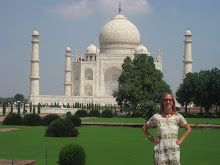
The Taj comes into view and it is shimmering against the blue sky behind it. It’s built right on the banks of the Jumna so there’s nothing behind it. It almost looks as if it’s floating: a massive, white, floating, glittering monument to love. I didn’t know what I’d think or feel when I saw it. People at work have told me that some people see it and are disappointed. It’s just a big building, after all. And then some people see it and are completely moved. I fall somewhere in between. It is beautiful. It is amazing to see something in person that I’ve seen reproduced so many times in pictures and movies. But there’s still something more I want to figure out while I’m here.
When my father’s father was in the hospital diagnosed with heart failure and nearing his death, he suddenly began talking about how he’d been to the Taj Mahal when he was in the service during World War II. He was not an effusive or emotional man. He never told stories. I’d never even heard him speak of being in the service. Yet here he was, nearly delirious, almost unable to speak, not talking about his dead wife or his remaining family, instead talking about this distant memory, talking about a few minutes spent walking around a tomb on the other side of the planet. Why?
We snap a bunch of photos and allow the Indians to take their pictures with us, then we finally approach the monument’s steps and have to put on our little white footies.
There is no photography allowed inside. We walk up to the headstones. In the center is Shah Jehan’s wife. His is right next to hers: the only detail that breaks the symmetry of the place. Vinni tells us this is because his son buried him here. The Shah was planning on building a black Taj across the river for himself, but his son imprisoned him in the Agra Fort and took over the empire, foiling his plans. His son didn’t care about symmetry or memory. His son cared about power.
I stand in front of the tombs imagining my grandfather in his twenties. He has to have stood here. How many millions of feet have stood here to see this grand gesture? To see a tomb?
So many monuments you see and you think about all the tortured craftsmen or even slaves that gave their toil and sometimes even lives to build. The Great Wall of China. The Pyramids. But the Taj isn’t like this. You don’t see the separate bricks that went into making it and imagine the people hauling them. You see one whole gesture. The building looks like one piece of air or cloud that arrived on earth because it was willed to do so. The Taj you look at and you just see love: delicate, timeless love. And I think as I stand where my grandfather must have stood, that this is what he must have seen as well, and this is what he must have remembered all those years later as his heart lost pace with his body and his mind drifted. We lose everything. Our spouses, our hearts, our minds. But what remains glistening like the Taj Mahal, untouchable by time, is only love. Nothing can touch it. Nothing can take it away.
I thank the Taj for yielding its secret to me and follow my friends out of the foyer past the intricate carved enclosure around the headstones.
Outside I realize that I’ve sweated so much that my clothes are soaked and sticking to me. I quickly drink the free bottle of water in an effort not to evaporate completely, but I am extremely uncomfortable. We walk thankfully into the shade of the trees leading down the path to the gate. There is no way I can dry off. Even once we reach the cool of the air conditioned van, I will be wet. I could probably literally wring the sweat from my shirt and pants. It’s disgusting. I just want to jump out of my clothes, but I have nothing to change into. I’ll just have to remain a puddle of yuck for the next unforeseen number of hours.
We meet Vinni back at the gate and he wants to know if we’ll go with him to see some Indian handicrafts. These are the places where he’ll get commission if we buy anything. We walk down the alley of vendors, including a Planet Hollywood, which is a dirty little shack with a metal garage door front that sells curried vegetables on metal plates. There are not even any Planet Hollywood t-shirts for sale.
This time packing back into the rickshaw is easier because we’re all so slippery. This time I don’t joke about smelling monkey on Uncle Dick because I’m sure I smell much worse. At least I’m not the only sweaty soul. Everyone is pretty well drenched.
We get back to our cab and the driver cranks up the a/c. Our next stop is a jewelry store where they sell stones mined in Agra: stars of India. They’re these stones used in the Taj Mahal that, when in direct light, produce a translucent star. They have pictures of these stones lit up at night and glistening in the Taj. I want to buy a ring to add to my collection, but the prices are high. I say I’m not going to spend more than fifty dollars, but they won’t come down. I leave the store and, as I’m climbing into the car, they change their mind. I can have the nice big stone I liked for fifty dollars. I’m their first customer today. It’s for good luck. I am always their first customer in India. I buy the ring as my souvenir of the Taj and we’re off to a rug place, that is, as soon as Vinni gets his cut of the cash.
In the next place we go, they are making rugs. It’s amazing to see them work. There are hundreds of threads stretched taught on this loom and the men are sitting, making knots in an intricate pattern of color with such speed that you can hardly tell what they’re doing. They make the knot, then cut the yarn, and make the knot, and cut the yarn. I don’t understand how they know where to put each color to make the detailed design they are making, but somehow they get it exactly correct just by having a picture of the design posted next to them.
The rug man takes us downstairs and show us where they create the design patterns for the rugs. He says the designs they make are hundreds of years old. Then he shows us a demonstration of how they trim the rugs once all the knots are made. Then he shows us how they have to use a little wooden stick to straighten out all the lines in the rug after it’s trimmed. All in all, it takes about four months to complete a typical rug made in this fashion.
They’re about to go into their sales pitch when we decide no one in our crowd wants a rug. Thankfully, the man isn’t too pushy and allows us to leave without argument.
The next stop is a place that does marble inlay work. The salesman here tells us that the people we’re looking at doing this work are descendants of the people that did the work at the Taj Mahal, that this is a trade that has been passed down through the families for hundreds of years.
He shows us how the craftsmen shape the pieces of precious and semi-precious stones on a grinding wheel, and how they scrape the exact shapes of these tiny pieces into the hard marble surfaces with tiny chisels. He shows us pieces less than a millimeter long that have several tinier pieces within them, mostly flower petals with stems and leaves. He takes us into a showroom and offers us tea. We decline. We can’t buy anything here. It’s all too expensive and large. They’re selling huge, heavy tables. Perhaps we’d like to see the room of smaller pieces, then?
He ushers us into a roomful of boxes and plates and elephants and coasters. Uncle Dick buys a set of elephant coasters for a good chunk of change, so good that they throw in a free elephant for him. Vinni says next we should eat lunch. We can eat at Pizza Hut, or there’s a Chinese place next door. We decide that Pizza Hut is fine. Vinni will leave us, then, but he gives us his business cards. They are handwritten in green ink with tiny lettering that tries to mimic a typewriter. We should call him if we ever need a tour guide in Agra again, and pass his name along to our friends. He wants my email address and Susie’s too because he knows we’ll both be in Delhi for a while yet. We tell him thanks, but it’s enough to have his contact information. He looks rejected, but sorry Vinni. No need to send me emails.
I’m still wet, but I’ve cooled off enough to realize that I’m also starving. It takes what seems like half an hour to decide on what pizzas to order, but we finally accomplish the task. I order a veggie and the crowd gets two chicken pizzas to split. Even though the veggie pizza costs about half of what the other ones cost, we split the bill evenly. I try not to be too George Castanza about this, but it seems like it always happens when I go out to eat. It’s truly no big deal, though. Susie paid for the auto-rickshaw on the way back from the Taj and Uncle Dick paid for it on the way there. Uncle Dick also got Vinni’s tip. It all evens out.
Next the driver stops at the Red Fort, the place where Shah Jehan was imprisoned. As we get out of the vehicle we are accosted by hawkers selling tiny marble inlaid boxes and marble elephants and fans made out of peacock feathers and tiny chess sets. One man tries to stick an elephant in my hand to get me to buy it. Another shoves one in my face. I make the mistake of showing a glimmer of interest and a crowd of them gather around me. “Chalo! Chalo!” I yell at them. Go away!
We walk all the way to the gate of the fort and Uncle Dick is framing up shot after shot, all the while the men are hounding me. “Madam, madam, a hundred rupees. One hundred rupees only!”
“Chalo!” I shout, then Susie looks at me.
“What are you telling them?” she asks. “Are you telling them ‘chalo’?”
Uh oh. Yes, I say, waiting for the bad news. “That means come here,” she says. “It means, like, let’s go. You’re telling them to come with you. You need to tell them ‘jao.’”
I look up and the men are laughing at me. “Jao,” I say, but this doesn’t work. One man jaws this word back at me like a twisted grammar school teacher. “Jaaaaooooo. Jaaaaooooo,” he says, laughing and laughing. Then they cram their merchandise back in my face. “Hundred rupees madam. One hundred rupees only.”
“Okay, I’m ready to go anytime,” I tell Uncle Dick, who is still framing up shots of the fort. “Anytime.”
Finally Uncle Dick is satisfied. We walk back with some effort because we are surrounded—especially me. Back at the car, the hawkers don’t let up. They stick their hands in and keep up their fevered pitches. Now there are better deals. “Madam, two for a hundred. All three for two hundred.” Russ hops back into the car. He has purchased a wooden chess set that he now can’t get opened. How much did he pay? 400 rupees. I think it sounds a bit expensive, but don’t say anything. It’s not like you can get your money back. I think these guys have a no return policy.
They won’t let Uncle Dick close the door, sticking their hands and their merchandise in, yelling out prices without abating. Finally the taxi driver starts pulling away. They walk with the vehicle, keeping on. Uncle Dick tries to close the door but they’re still there. It’s like we’re being attached by an octopus or two or three who’ve gotten into a trunk of sunken treasure. There are arms everywhere with the goodies we just can’t live without. Finally we pull out into traffic and the men have to give up.
A few miles down the road we stop at Akbar’s Tomb. I’m kind of tombed out, I think, until I see it and remember Amar telling me about it. Some people like it better than the Taj Mahal even. It’s more intricate, with more designs on it. It’s captivating. And the grounds are like a zoo, with hoards of semi-tame monkeys and deer and peacocks that have been there for years. Akbar would have wanted it that way.
Half way up to the tomb, I get an ocular migraine, the kind wherein I go partially blind because there’s a big flashing blob in front of my face for about fifteen minutes. But I don’t let it come between me and the monkeys. I take picture after picture and get some great video of three baby monkeys taking turns jumping off a bench.
I can’t say I’m surprised by my migraine, going from such extreme hot to the air conditioning over and over during the day. I would just like for it to go away. I would like to be dry, and I would like my migraine to go away.
Inside the tomb there is a guide looking for a tip. He tells us some trivia about Akbar that I can’t pay much attention to because I’m partially blind and still wet. We travel down a long, narrow passage to a plain room that houses Akbar’s headstone. Here a man in Muslim dress gives us each a handful of flower petals and tells us to throw them onto the tomb. I follow the instructions. Then he tells us we should leave money on the tomb. No one else does, but I get out some coins and set them down. “Two rupees!” the man cries like I’m the biggest cheapskate in the world. The other tour guide goes on about how there’s a five second echo in the room. Two rupees! I hear again. Shove it mister. I’m half blind and all wet. You’re lucky you got that.
The interminable tour guide takes us into the neighboring chamber where Akbar’s daughter is buried and shows us a trick of the acoustics in this room. If you whisper into one of the corners, you can be heard on the opposite side of the room. He hopes we enjoyed the information he says, holding out his hand with a ten rupee note cupped into it to show us just exactly what we should do. Someone gives him a tip. I am out of change, so I can’t.
Walking back to the car we are greeted by hawkers with the same merchandise they were selling outside the Red Fort. There are elephants and fans and boxes and chess sets. Except everything here is about half the price. They are asking two hundred rupees for poor Russ’s chess set. I pay a man and get a large green carved elephant for a hundred rupees. As I pass to the car, a man pushes another man in front of me. This man’s eyes are all white. He holds a few ugly necklaces. “Madam, there is a blind man here,” his helper points out the obvious, hoping this will incite me to buy. It is a unique pitch. But I am hot, I am still wet and I am now in pain from the pounding headache that always follows my temporary blindness. I jump around the blind man and make for the Toyota with Russ.
We are the first ones there. Uncle Dick has stayed behind to dicker with a hawker over a chess set. I think he gets one for a hundred rupees, or two hundred. I don’t much care. I just want the air in the car to dry me off. I just want to lean back and close my eyes and recuperate from the day.
We are all finally in the car and the driver cranks up the a/c and pulls away. We are on our way home. The air gives me goose bumps but I love it. I could close the vent that is blowing on me, but I don’t. For once in my life, I enjoy being cold. I take a nap. I think everyone in the car takes a nap. It’s comfortable and quiet, and it’s been a long day. Travel in India is not a spectator sport. You get jostled around. You need your elbows. Your senses are overloaded. Your clothes are dirtied. Your patience is tried. You are tired out when you are done.
We drop off Russ at Nizamuddin and reach the Ahuja Residency around eight thirty. I say goodbye to Uncle Dick and Katie and thank Susie for what was a totally smooth and fun and comparatively easy trip to see the Taj. If I were going again, this is the way I’d want to do it. There was no messing with auto wallahs or worrying about missing trains or busses.
Upstairs in my room, I call Scott to let him know I’m home safely. Then I pick the last three biscuits from my fridge and head out to see if Acha, Baby and Baloo are hungry. Before I can find my dogs, I find my neighbors. Mister Kandhari is in his courtyard. “I call you! I call you!” he says excitedly. I tell him just as excitedly that I just got back from the Taj Mahal.
“Come to our temple,” he says.
“Now?” I ask.
“Yes,” he says.
“Okay,” I say. “I just need to give these biscuits to the dogs.” I run around the corner and leave the biscuits on the ground, then climb into Mister Kandhari’s car along with Mister Singh and Gopi. The Defence Colony gurudwara is only, like, two blocks away. We park and get out. There are no footbaths here, only a sink in which I am told to wash my hands. We check our shoes and Mister Singh produces a white bandana with which I can cover my head. We stand outside. Inside there is a golden arch and a man singing a raga. There is another man who looks to be waiving a feather duster over the large copy of the Guru Granth Sahib, the Sikh holy book. We wait outside for a break in the music, then Mister Singh motions for me to follow him in. The singing and chanting continues and pages in the book are turned. Mister Singh walks a few paces to the left to sit down. I’m glad I don’t immediately follow him because I notice that all the women are sitting to the right. I stay where I am and sit with the women. I’m not as worried about getting separated from my hosts at this gurudwara. It’s small and not as crowded as Bangla Sahib. It’s also close to home. If all else fails, I can walk home from here.
The chanting continues, then the book is covered with a golden cloth. The man comes back with the feather duster. Then a man comes around with the brown glop. Before I can think, I hold my hands out and get the warm goo straight from the hand of the man scooping it out. There are no garbage cans around. This is a whole ceremony. There’s no getting out of eating the goo this time. I take a taste. It’s something like cream of wheat with a hint of brown sugar. It’s not bad. I think, I’ll have to ask Mister Singh what the significance of this is when I get the chance. The woman sitting next to me feeds her goo to a tiny little girl crawling around the floor in an adorable yellow halter top and white frilly pants. The baby gets full of goo then gets interested in my rings, touching them with her tiny gooey fingers. The song goes on and a young boy is presented in front of the crowd. A large wreath of yellow flowers is hung over his head and some words are read.
Finally, the Gugu Granth Sahib is put on a cushion and covered in golden cloths. Everyone touches their heads to the ground as the book is raised and carried to the glass chamber where it is kept every night. Sikhs have this ceremony in the morning and the evening every day.
After the bible goes to bed, people mill about the clean, plush carpeted room. Mister Singh introduces me to a childhood friend of his who is impressed that I’m going to see the Golden Temple this coming weekend. He touches my head as in a blessing and tells me that I’ll be close to God when I go.
“Come, Vicki, come!” Mister Kandhari wants me to follow him. “I call you. I call you just a half hour ago, then you come. It is good. We’ll eat some dinner.”
Downstairs, a big meal is being served. Mister Singh explains it is for the occasion of the child being accepted into the church, the little boy who got the wreath of flowers placed on him just a few minutes ago. The family wanted to do this.
There are easily two hundred people in the gurudwara basement. We sit down in a row of chairs. Mister Singh said there never used to be chairs, but then they put them here for the people who are getting older and having trouble with their knees.
Young men come around with buckets and ladles and serve dal, then paneer, then a cucumber salad and finally kheer or rice pudding, as Mister Singh explains it to me.
He tells me for the third or maybe forth time how the Hindus have four castes, but the Sikhs think caste is wrong. Human beings are human beings, you see. That’s why the Sikhs serve food like this, where everyone can sit together, regardless of caste or religion.
“Happy?” Mister Kandhari asks me as he walks past with his empty plate.
“Yes, very,” I reply, as I always do when he asks this question.
The food is good and the meal is over quickly. An old man takes my plate away when I am finished. Then we meet up with Mister Singh’s childhood friend. He begins to tell me how the Sikhs think caste is wrong, but I have to excuse myself. It appears that my ride is leaving.
“Come, Vicki, come,” Mister Kandhari says and begins to teeter up the stairs. I follow Mister Singh to the shoe check and wash my hands. Mister Kandhari gets back into his car with great effort and a few grunts. They drop me off at the guesthouse less than an hour after I left planning just to feed a few biscuits to a few stray dogs.
It’s been a long, lovely day, but I’m certainly ready for a long, lovely sleep.
Monday I awaken at six, completely refreshed from my day of rest. I gather my things: my cell phone, my camera, a water bottle, my umbrella. I’m getting ready to go to the Taj Mahal today with Susie, Katie, Susie’s Uncle Dick and the father of this girl from church who has to work today. His name is Russ.
Susie calls at six fifteen just as she said she would. They are on their way. We are actually going. This trip has been quasi-planned and cancelled innumerable times because of Uncle Dick’s changing travel plans. Today it’s finally happening.
I climb into the way back of the big Toyota van next to Russ. Russ just got here late on Friday, so he still has jet lag and his head is still spinning from the sensory overload that is India to the uninitiated. He is full of questions. He asks me what I'm doing here and how long I've been here. He wants to know about Susie, too. How long has she been here? Two years. How often has she gone home? She hasn’t.
She hasn’t?
She hasn’t gone home in two years?
It strikes me now that Susie is having a kind of Into the Wild Christopher McCandless experience, that she would be fine starving to death on a bus by herself having eaten moldy seeds, that she is at total peace out here on her own, peace with a twinge of nihilistic oblivion somewhere at the end of it. Two years without going home. I could never do it.
Russ and Uncle Dick snap pictures out the window of the car, framing up shots of overstuffed auto-rickshaws and motorcycles holding whole families: the sites that I now take for granted. It is fun to have people around for whom this is all new. It makes me see my surroundings with different eyes.
The back seat of the Toyota is killing my back until we discover we can adjust the headrest so it’s not in the middle of our backs. After that, the ride is bearable, even comfortable. We each have our own air conditioning vent and the car remains cool as we drive through towns and countryside. There is a lot of open farmland on the way to Agra, and every time there is farmland, there are also the grass huts of the agricultural workers. I am amazed to see them. They are like something from a Gauguin painting, but real. People live in them. I try to reconcile this with all the boys we see in school uniforms in the populated areas getting ready to go to school. I can’t. There are two Indias: one for the educated and one for the workers, the people who live in grass huts in the country and tents in the cities, the little boys who persistently try to sell magazines to people in traffic. Sometimes I am annoyed by these boys when they won’t go away; sometimes I admire their happy resilience so much.
We get stopped at some kind of border crossing where our cab driver has to show some papers to an official. While this is happening, men with monkeys on strings approach the car. Uncle Dick wants a picture. The monkey man tells Uncle Dick to get out of the car. He can have his picture with the monkeys. Uncle Dick hops out and one of the monkeys leaps onto his shoulders, perching there for the photo. Another monkey hops onto the end of a large stick. He is surrounded by monkey. Susie takes the shot. Once it’s done the man wants 500 rupees or ten dollars. This is a little much. My whole elephant ride cost that much, and Sonu told me it was way too much. Susie passes the man twenty rupees and tells her uncle to get in the car, but the man won’t let him close the door. “Very poor man. Very poor,” he tells us.
“He’s not poor,” Susie says. “People don’t know better and they all pay him that much.” But I don’t see carloads of people cueing up to get their picture with this man and his monkeys. The cab starts to pull away and the man’s hands are still reaching into the car. Finally he gives up and lets us go. Uncle Dick notices a monkey smell and asks if he has any souvenirs on the back of his shirt, but he’s clean. It’s just the lingering scent of his little furry friend.
After about three hours we arrive in Agra. Our cabdriver pulls over to the side of the road and a man approaches the vehicle. He is Vinni, our tour guide. We say we don’t want a tour guide. How much will he cost? But he tells us he is included in the price of the cab. He’ll just appreciate a tip when he’s done. Can he get in? No one told Susie anything about a tour guide when she booked the cab, but we figure it’s okay. He’s well dressed and well spoken. He seems kosher.
If we didn’t have two strapping men with us, this might have been an issue, but as it is, Katie climbs into the back bench seat with Russ and me and gives up her seat to Vinni who starts explaining how we have to get to the Taj.
Several years ago, the conservators of the building noticed the white marble starting to yellow from pollution, so now there is a ban on gas-powered vehicles within two kilometers of the place. We’ll have to park then take an electric auto-rickshaw. The cab pulls over and Vinni hails a rickshaw. He tells us all to get in: all six of us. Susie sits on the side bar and Katie and Uncle Dick smash into the back seat. I sit very close to Uncle Dick and ask him about that funky smell. Eau de monkey, I believe? Vinni and Russ sit with the auto driver in the front on a seat that is built for one. In this very Indian manner, we crawl the short distance to the gate. It is somewhat amazing that the electric motor can handle all the weight we’re pulling. As we approach the gate, Vinni tells us to beware of pick-pockets and aggressive vendors. I’m glad he’s with us. He’s been very helpful already.
We walk down a sidewalk-width street lined with tiny shops selling cheesy souvenirs like snow globes and magnets. The vendors are surprisingly mild. I don’t even get accosted. At the gate, it is revealed that Indian citizens pay twenty rupees while foreigners pay seven hundred and fifty to get in. We fork over the cash to Vinni and he secures our tickets for us. He takes us to a second booth where they provide each one of us with a bottle of cold water and covers for our shoes that we’ll have to wear when we reach the tomb.
We walk through the gate and Vinni has lots of information for us: how tall the building is, how many towers there are, how it’s built with exact symmetry, how the towers slightly lean outwards. I am interested mostly in the story of why it was built by Shah Jehan: as a monument for his second wife who died in childbirth.
The Taj comes into view and it is shimmering against the blue sky behind it. It’s built right on the banks of the Jumna so there’s nothing behind it. It almost looks as if it’s floating: a massive, white, floating, glittering monument to love. I didn’t know what I’d think or feel when I saw it. People at work have told me that some people see it and are disappointed. It’s just a big building, after all. And then some people see it and are completely moved. I fall somewhere in between. It is beautiful. It is amazing to see something in person that I’ve seen reproduced so many times in pictures and movies. But there’s still something more I want to figure out while I’m here.
When my father’s father was in the hospital diagnosed with heart failure and nearing his death, he suddenly began talking about how he’d been to the Taj Mahal when he was in the service during World War II. He was not an effusive or emotional man. He never told stories. I’d never even heard him speak of being in the service. Yet here he was, nearly delirious, almost unable to speak, not talking about his dead wife or his remaining family, instead talking about this distant memory, talking about a few minutes spent walking around a tomb on the other side of the planet. Why?
We snap a bunch of photos and allow the Indians to take their pictures with us, then we finally approach the monument’s steps and have to put on our little white footies.
There is no photography allowed inside. We walk up to the headstones. In the center is Shah Jehan’s wife. His is right next to hers: the only detail that breaks the symmetry of the place. Vinni tells us this is because his son buried him here. The Shah was planning on building a black Taj across the river for himself, but his son imprisoned him in the Agra Fort and took over the empire, foiling his plans. His son didn’t care about symmetry or memory. His son cared about power.
I stand in front of the tombs imagining my grandfather in his twenties. He has to have stood here. How many millions of feet have stood here to see this grand gesture? To see a tomb?
So many monuments you see and you think about all the tortured craftsmen or even slaves that gave their toil and sometimes even lives to build. The Great Wall of China. The Pyramids. But the Taj isn’t like this. You don’t see the separate bricks that went into making it and imagine the people hauling them. You see one whole gesture. The building looks like one piece of air or cloud that arrived on earth because it was willed to do so. The Taj you look at and you just see love: delicate, timeless love. And I think as I stand where my grandfather must have stood, that this is what he must have seen as well, and this is what he must have remembered all those years later as his heart lost pace with his body and his mind drifted. We lose everything. Our spouses, our hearts, our minds. But what remains glistening like the Taj Mahal, untouchable by time, is only love. Nothing can touch it. Nothing can take it away.
I thank the Taj for yielding its secret to me and follow my friends out of the foyer past the intricate carved enclosure around the headstones.
Outside I realize that I’ve sweated so much that my clothes are soaked and sticking to me. I quickly drink the free bottle of water in an effort not to evaporate completely, but I am extremely uncomfortable. We walk thankfully into the shade of the trees leading down the path to the gate. There is no way I can dry off. Even once we reach the cool of the air conditioned van, I will be wet. I could probably literally wring the sweat from my shirt and pants. It’s disgusting. I just want to jump out of my clothes, but I have nothing to change into. I’ll just have to remain a puddle of yuck for the next unforeseen number of hours.
We meet Vinni back at the gate and he wants to know if we’ll go with him to see some Indian handicrafts. These are the places where he’ll get commission if we buy anything. We walk down the alley of vendors, including a Planet Hollywood, which is a dirty little shack with a metal garage door front that sells curried vegetables on metal plates. There are not even any Planet Hollywood t-shirts for sale.
This time packing back into the rickshaw is easier because we’re all so slippery. This time I don’t joke about smelling monkey on Uncle Dick because I’m sure I smell much worse. At least I’m not the only sweaty soul. Everyone is pretty well drenched.
We get back to our cab and the driver cranks up the a/c. Our next stop is a jewelry store where they sell stones mined in Agra: stars of India. They’re these stones used in the Taj Mahal that, when in direct light, produce a translucent star. They have pictures of these stones lit up at night and glistening in the Taj. I want to buy a ring to add to my collection, but the prices are high. I say I’m not going to spend more than fifty dollars, but they won’t come down. I leave the store and, as I’m climbing into the car, they change their mind. I can have the nice big stone I liked for fifty dollars. I’m their first customer today. It’s for good luck. I am always their first customer in India. I buy the ring as my souvenir of the Taj and we’re off to a rug place, that is, as soon as Vinni gets his cut of the cash.
In the next place we go, they are making rugs. It’s amazing to see them work. There are hundreds of threads stretched taught on this loom and the men are sitting, making knots in an intricate pattern of color with such speed that you can hardly tell what they’re doing. They make the knot, then cut the yarn, and make the knot, and cut the yarn. I don’t understand how they know where to put each color to make the detailed design they are making, but somehow they get it exactly correct just by having a picture of the design posted next to them.
The rug man takes us downstairs and show us where they create the design patterns for the rugs. He says the designs they make are hundreds of years old. Then he shows us a demonstration of how they trim the rugs once all the knots are made. Then he shows us how they have to use a little wooden stick to straighten out all the lines in the rug after it’s trimmed. All in all, it takes about four months to complete a typical rug made in this fashion.
They’re about to go into their sales pitch when we decide no one in our crowd wants a rug. Thankfully, the man isn’t too pushy and allows us to leave without argument.
The next stop is a place that does marble inlay work. The salesman here tells us that the people we’re looking at doing this work are descendants of the people that did the work at the Taj Mahal, that this is a trade that has been passed down through the families for hundreds of years.
He shows us how the craftsmen shape the pieces of precious and semi-precious stones on a grinding wheel, and how they scrape the exact shapes of these tiny pieces into the hard marble surfaces with tiny chisels. He shows us pieces less than a millimeter long that have several tinier pieces within them, mostly flower petals with stems and leaves. He takes us into a showroom and offers us tea. We decline. We can’t buy anything here. It’s all too expensive and large. They’re selling huge, heavy tables. Perhaps we’d like to see the room of smaller pieces, then?
He ushers us into a roomful of boxes and plates and elephants and coasters. Uncle Dick buys a set of elephant coasters for a good chunk of change, so good that they throw in a free elephant for him. Vinni says next we should eat lunch. We can eat at Pizza Hut, or there’s a Chinese place next door. We decide that Pizza Hut is fine. Vinni will leave us, then, but he gives us his business cards. They are handwritten in green ink with tiny lettering that tries to mimic a typewriter. We should call him if we ever need a tour guide in Agra again, and pass his name along to our friends. He wants my email address and Susie’s too because he knows we’ll both be in Delhi for a while yet. We tell him thanks, but it’s enough to have his contact information. He looks rejected, but sorry Vinni. No need to send me emails.
I’m still wet, but I’ve cooled off enough to realize that I’m also starving. It takes what seems like half an hour to decide on what pizzas to order, but we finally accomplish the task. I order a veggie and the crowd gets two chicken pizzas to split. Even though the veggie pizza costs about half of what the other ones cost, we split the bill evenly. I try not to be too George Castanza about this, but it seems like it always happens when I go out to eat. It’s truly no big deal, though. Susie paid for the auto-rickshaw on the way back from the Taj and Uncle Dick paid for it on the way there. Uncle Dick also got Vinni’s tip. It all evens out.
Next the driver stops at the Red Fort, the place where Shah Jehan was imprisoned. As we get out of the vehicle we are accosted by hawkers selling tiny marble inlaid boxes and marble elephants and fans made out of peacock feathers and tiny chess sets. One man tries to stick an elephant in my hand to get me to buy it. Another shoves one in my face. I make the mistake of showing a glimmer of interest and a crowd of them gather around me. “Chalo! Chalo!” I yell at them. Go away!
We walk all the way to the gate of the fort and Uncle Dick is framing up shot after shot, all the while the men are hounding me. “Madam, madam, a hundred rupees. One hundred rupees only!”
“Chalo!” I shout, then Susie looks at me.
“What are you telling them?” she asks. “Are you telling them ‘chalo’?”
Uh oh. Yes, I say, waiting for the bad news. “That means come here,” she says. “It means, like, let’s go. You’re telling them to come with you. You need to tell them ‘jao.’”
I look up and the men are laughing at me. “Jao,” I say, but this doesn’t work. One man jaws this word back at me like a twisted grammar school teacher. “Jaaaaooooo. Jaaaaooooo,” he says, laughing and laughing. Then they cram their merchandise back in my face. “Hundred rupees madam. One hundred rupees only.”
“Okay, I’m ready to go anytime,” I tell Uncle Dick, who is still framing up shots of the fort. “Anytime.”
Finally Uncle Dick is satisfied. We walk back with some effort because we are surrounded—especially me. Back at the car, the hawkers don’t let up. They stick their hands in and keep up their fevered pitches. Now there are better deals. “Madam, two for a hundred. All three for two hundred.” Russ hops back into the car. He has purchased a wooden chess set that he now can’t get opened. How much did he pay? 400 rupees. I think it sounds a bit expensive, but don’t say anything. It’s not like you can get your money back. I think these guys have a no return policy.
They won’t let Uncle Dick close the door, sticking their hands and their merchandise in, yelling out prices without abating. Finally the taxi driver starts pulling away. They walk with the vehicle, keeping on. Uncle Dick tries to close the door but they’re still there. It’s like we’re being attached by an octopus or two or three who’ve gotten into a trunk of sunken treasure. There are arms everywhere with the goodies we just can’t live without. Finally we pull out into traffic and the men have to give up.
A few miles down the road we stop at Akbar’s Tomb. I’m kind of tombed out, I think, until I see it and remember Amar telling me about it. Some people like it better than the Taj Mahal even. It’s more intricate, with more designs on it. It’s captivating. And the grounds are like a zoo, with hoards of semi-tame monkeys and deer and peacocks that have been there for years. Akbar would have wanted it that way.
Half way up to the tomb, I get an ocular migraine, the kind wherein I go partially blind because there’s a big flashing blob in front of my face for about fifteen minutes. But I don’t let it come between me and the monkeys. I take picture after picture and get some great video of three baby monkeys taking turns jumping off a bench.
I can’t say I’m surprised by my migraine, going from such extreme hot to the air conditioning over and over during the day. I would just like for it to go away. I would like to be dry, and I would like my migraine to go away.
Inside the tomb there is a guide looking for a tip. He tells us some trivia about Akbar that I can’t pay much attention to because I’m partially blind and still wet. We travel down a long, narrow passage to a plain room that houses Akbar’s headstone. Here a man in Muslim dress gives us each a handful of flower petals and tells us to throw them onto the tomb. I follow the instructions. Then he tells us we should leave money on the tomb. No one else does, but I get out some coins and set them down. “Two rupees!” the man cries like I’m the biggest cheapskate in the world. The other tour guide goes on about how there’s a five second echo in the room. Two rupees! I hear again. Shove it mister. I’m half blind and all wet. You’re lucky you got that.
The interminable tour guide takes us into the neighboring chamber where Akbar’s daughter is buried and shows us a trick of the acoustics in this room. If you whisper into one of the corners, you can be heard on the opposite side of the room. He hopes we enjoyed the information he says, holding out his hand with a ten rupee note cupped into it to show us just exactly what we should do. Someone gives him a tip. I am out of change, so I can’t.
Walking back to the car we are greeted by hawkers with the same merchandise they were selling outside the Red Fort. There are elephants and fans and boxes and chess sets. Except everything here is about half the price. They are asking two hundred rupees for poor Russ’s chess set. I pay a man and get a large green carved elephant for a hundred rupees. As I pass to the car, a man pushes another man in front of me. This man’s eyes are all white. He holds a few ugly necklaces. “Madam, there is a blind man here,” his helper points out the obvious, hoping this will incite me to buy. It is a unique pitch. But I am hot, I am still wet and I am now in pain from the pounding headache that always follows my temporary blindness. I jump around the blind man and make for the Toyota with Russ.
We are the first ones there. Uncle Dick has stayed behind to dicker with a hawker over a chess set. I think he gets one for a hundred rupees, or two hundred. I don’t much care. I just want the air in the car to dry me off. I just want to lean back and close my eyes and recuperate from the day.
We are all finally in the car and the driver cranks up the a/c and pulls away. We are on our way home. The air gives me goose bumps but I love it. I could close the vent that is blowing on me, but I don’t. For once in my life, I enjoy being cold. I take a nap. I think everyone in the car takes a nap. It’s comfortable and quiet, and it’s been a long day. Travel in India is not a spectator sport. You get jostled around. You need your elbows. Your senses are overloaded. Your clothes are dirtied. Your patience is tried. You are tired out when you are done.
We drop off Russ at Nizamuddin and reach the Ahuja Residency around eight thirty. I say goodbye to Uncle Dick and Katie and thank Susie for what was a totally smooth and fun and comparatively easy trip to see the Taj. If I were going again, this is the way I’d want to do it. There was no messing with auto wallahs or worrying about missing trains or busses.
Upstairs in my room, I call Scott to let him know I’m home safely. Then I pick the last three biscuits from my fridge and head out to see if Acha, Baby and Baloo are hungry. Before I can find my dogs, I find my neighbors. Mister Kandhari is in his courtyard. “I call you! I call you!” he says excitedly. I tell him just as excitedly that I just got back from the Taj Mahal.
“Come to our temple,” he says.
“Now?” I ask.
“Yes,” he says.
“Okay,” I say. “I just need to give these biscuits to the dogs.” I run around the corner and leave the biscuits on the ground, then climb into Mister Kandhari’s car along with Mister Singh and Gopi. The Defence Colony gurudwara is only, like, two blocks away. We park and get out. There are no footbaths here, only a sink in which I am told to wash my hands. We check our shoes and Mister Singh produces a white bandana with which I can cover my head. We stand outside. Inside there is a golden arch and a man singing a raga. There is another man who looks to be waiving a feather duster over the large copy of the Guru Granth Sahib, the Sikh holy book. We wait outside for a break in the music, then Mister Singh motions for me to follow him in. The singing and chanting continues and pages in the book are turned. Mister Singh walks a few paces to the left to sit down. I’m glad I don’t immediately follow him because I notice that all the women are sitting to the right. I stay where I am and sit with the women. I’m not as worried about getting separated from my hosts at this gurudwara. It’s small and not as crowded as Bangla Sahib. It’s also close to home. If all else fails, I can walk home from here.
The chanting continues, then the book is covered with a golden cloth. The man comes back with the feather duster. Then a man comes around with the brown glop. Before I can think, I hold my hands out and get the warm goo straight from the hand of the man scooping it out. There are no garbage cans around. This is a whole ceremony. There’s no getting out of eating the goo this time. I take a taste. It’s something like cream of wheat with a hint of brown sugar. It’s not bad. I think, I’ll have to ask Mister Singh what the significance of this is when I get the chance. The woman sitting next to me feeds her goo to a tiny little girl crawling around the floor in an adorable yellow halter top and white frilly pants. The baby gets full of goo then gets interested in my rings, touching them with her tiny gooey fingers. The song goes on and a young boy is presented in front of the crowd. A large wreath of yellow flowers is hung over his head and some words are read.
Finally, the Gugu Granth Sahib is put on a cushion and covered in golden cloths. Everyone touches their heads to the ground as the book is raised and carried to the glass chamber where it is kept every night. Sikhs have this ceremony in the morning and the evening every day.
After the bible goes to bed, people mill about the clean, plush carpeted room. Mister Singh introduces me to a childhood friend of his who is impressed that I’m going to see the Golden Temple this coming weekend. He touches my head as in a blessing and tells me that I’ll be close to God when I go.
“Come, Vicki, come!” Mister Kandhari wants me to follow him. “I call you. I call you just a half hour ago, then you come. It is good. We’ll eat some dinner.”
Downstairs, a big meal is being served. Mister Singh explains it is for the occasion of the child being accepted into the church, the little boy who got the wreath of flowers placed on him just a few minutes ago. The family wanted to do this.
There are easily two hundred people in the gurudwara basement. We sit down in a row of chairs. Mister Singh said there never used to be chairs, but then they put them here for the people who are getting older and having trouble with their knees.
Young men come around with buckets and ladles and serve dal, then paneer, then a cucumber salad and finally kheer or rice pudding, as Mister Singh explains it to me.
He tells me for the third or maybe forth time how the Hindus have four castes, but the Sikhs think caste is wrong. Human beings are human beings, you see. That’s why the Sikhs serve food like this, where everyone can sit together, regardless of caste or religion.
“Happy?” Mister Kandhari asks me as he walks past with his empty plate.
“Yes, very,” I reply, as I always do when he asks this question.
The food is good and the meal is over quickly. An old man takes my plate away when I am finished. Then we meet up with Mister Singh’s childhood friend. He begins to tell me how the Sikhs think caste is wrong, but I have to excuse myself. It appears that my ride is leaving.
“Come, Vicki, come,” Mister Kandhari says and begins to teeter up the stairs. I follow Mister Singh to the shoe check and wash my hands. Mister Kandhari gets back into his car with great effort and a few grunts. They drop me off at the guesthouse less than an hour after I left planning just to feed a few biscuits to a few stray dogs.
It’s been a long, lovely day, but I’m certainly ready for a long, lovely sleep.
Tuesday, September 16, 2008
One More Nap
Sunday
The phone rings. It’s Julianne. She’s calling because she’s on the way to pick me up for church, but Jonaki is still sleeping. I tell Julianne I’ll have to skip church today. I’m in no condition for worship anyway. If it was painful last week after the gurudwara, it would be excruciating after my date with Indian wine which, I’m finding, seems a lot stronger than the kind I’m used to, or maybe it’s just that my tolerance is down because I’ve been drinking so little while I’ve been here. Either way, I feel like I might get sick.
Jonaki awakens shortly after Julianne’s phone call, springs up and gets dressed in just a few quick minutes. She’s going to call a cab. The hotel wants to charge her for a full day at first just to drive her home. She says she only got stuck here because of the bomb blasts, why are they taking advantage of her? They say ok. They’ll charge for a half day. It’s still exorbitant for a ride across town. She tries two other services. One leaves her on hold for ten minutes then tells her they don’t have cab in our area. They can’t help. She can’t get through at all to the other number.
She goes downstairs and has some breakfast while I stay upstairs, sitting in a chair with my eyes closed, hoping not to get sick. Jonaki walks out to the gate and finds an auto who will take her for 125 rupees. This is a quarter of what the cab service through the hotel was asking. She’s only worried about the border crossing. She lives in a different state. Delhi is kind of like Washington D.C. It’s its own state. Because of the bombs, Jonaki wonders if the border will be locked down and she won’t be able to switch autos like she normally does when going home. But it works out okay. She gets home fine.
In the meantime, I sleep and sleep and sleep. In fact, I pass the whole day lounging around in bed, watching BBC World News and CNN IBN. Turns out they found a few more bombs that didn’t detonate. One was at India Gate. The others were in a place I don’t recognize. There was an email sent to the press a few minutes before the bombs went off. It said there were nine bombs in all. Something like seven have been found or exploded so far.
Sunday I don’t even have the energy to blog. I am sapped. Drained. Empty. Nothing personally happened to me or anyone I know in connection with the bombings. I have no right to feel like I survived something stressful. All I did was stay in my guesthouse. Still, I do. I feel like I need a day to adjust to this new reality: a Delhi that explodes right under you, a Delhi with blood stains in its markets and auto-rickshaws. It’s sad. When I am trying not to get sick, I feel sad that my safe Delhi is gone. There will always be the question of danger now in my head. I will always feel a little on edge in the markets. I will steer clear of garbage cans, and who knows if I can climb into a rickshaw again? I probably will. I will be one of the hearty Delhiites who go on after an attack, because, really, what else can you do? Hole up and stop talking to people? Stop going places and doing things? Stop living? That’s no kind of life. There is no choice but to return to normal eventually.
After I take another nap, though.
The phone rings. It’s Julianne. She’s calling because she’s on the way to pick me up for church, but Jonaki is still sleeping. I tell Julianne I’ll have to skip church today. I’m in no condition for worship anyway. If it was painful last week after the gurudwara, it would be excruciating after my date with Indian wine which, I’m finding, seems a lot stronger than the kind I’m used to, or maybe it’s just that my tolerance is down because I’ve been drinking so little while I’ve been here. Either way, I feel like I might get sick.
Jonaki awakens shortly after Julianne’s phone call, springs up and gets dressed in just a few quick minutes. She’s going to call a cab. The hotel wants to charge her for a full day at first just to drive her home. She says she only got stuck here because of the bomb blasts, why are they taking advantage of her? They say ok. They’ll charge for a half day. It’s still exorbitant for a ride across town. She tries two other services. One leaves her on hold for ten minutes then tells her they don’t have cab in our area. They can’t help. She can’t get through at all to the other number.
She goes downstairs and has some breakfast while I stay upstairs, sitting in a chair with my eyes closed, hoping not to get sick. Jonaki walks out to the gate and finds an auto who will take her for 125 rupees. This is a quarter of what the cab service through the hotel was asking. She’s only worried about the border crossing. She lives in a different state. Delhi is kind of like Washington D.C. It’s its own state. Because of the bombs, Jonaki wonders if the border will be locked down and she won’t be able to switch autos like she normally does when going home. But it works out okay. She gets home fine.
In the meantime, I sleep and sleep and sleep. In fact, I pass the whole day lounging around in bed, watching BBC World News and CNN IBN. Turns out they found a few more bombs that didn’t detonate. One was at India Gate. The others were in a place I don’t recognize. There was an email sent to the press a few minutes before the bombs went off. It said there were nine bombs in all. Something like seven have been found or exploded so far.
Sunday I don’t even have the energy to blog. I am sapped. Drained. Empty. Nothing personally happened to me or anyone I know in connection with the bombings. I have no right to feel like I survived something stressful. All I did was stay in my guesthouse. Still, I do. I feel like I need a day to adjust to this new reality: a Delhi that explodes right under you, a Delhi with blood stains in its markets and auto-rickshaws. It’s sad. When I am trying not to get sick, I feel sad that my safe Delhi is gone. There will always be the question of danger now in my head. I will always feel a little on edge in the markets. I will steer clear of garbage cans, and who knows if I can climb into a rickshaw again? I probably will. I will be one of the hearty Delhiites who go on after an attack, because, really, what else can you do? Hole up and stop talking to people? Stop going places and doing things? Stop living? That’s no kind of life. There is no choice but to return to normal eventually.
After I take another nap, though.
Subscribe to:
Posts (Atom)